Friday, February 27, 2009

Mixed Results

I finished the lined top yesterday and photographed it this morning--on my manequin which is obviously several sizes smaller than I am.

I ironed it yesterday, really, I did! But it spent the night scrunched up on a chair in my bedroom after I realised I couldn't really wear it.

The construction is fine.

  • * The lining all sits nicely.
  • * I even managed the crazy inside-out trick of sewing the outer shoulder seam from within a space only a few inches across, which was necessary to finish it all off with no raw edges visible
  • * and I've pretty much got the fit of these tops down pat, since I've made several of them recently. It fits a lot better on me than it does on the manequin.

I like the colour. And of course, the whole point of the exercise was that it would team up with the skirt I made myself a few weeks ago.

But . . . I made a significant tactical blunder, and as soon as I put it on to wear it yesterday and looked at myself in the mirror it was glaringly obvious. The lower front section of the top is several shades lighter than the upper front section. And the skirt is, of course, the same colour as the upper front section. Which leaves me with a big band of lighter colour right across my middle. At 5-foot 2 and a bit inches with a waist measurement of 114 cm and a DD or E cup bust fitting, I just can't afford to have a big band of lighter colour right across my middle!

So, I've been reminded of something I ought to have known: beware of colour placement! I can see how I made the mistake. I thought about the colour placement in terms of the top itself, and even though the hand-dyed fabric was lighter, I though I'd get away with it because it seemed to match pretty well, but I didn't think about what else I would be wearing with this top. There's no way I would wear a skirt or pants in as light a colour as the hand-dye. The only rescue I can think of at this stage is to throw the whole thing into a dye bath when I next have a suitable colour handy and see if I can get the colour more uniform. Of course, then it won't match the skirt, unless I throw that in the dye bath too.

Thursday, February 26, 2009

Curved Seams

I am still working on the teal singlet top. For an afterthought, it's taken a lot of time and attention. I'm hoping I didn't promise a step-by-step for the lining process, because it's just not going to happen. The lining is happening, but the step-by-step is not. I'm making it up as I go along and that's not a good recipe for demonstrating. Now I know why, "here's one I prepared earlier" is such a well used line.

This morning I'm sorting out the curved seams on the armholes and neckline. I've stitched the two layers together and the next step is to turn the lining in to the inside. Here's the neckline seam:

I've trimmed and clipped the curved seam to reduce bulk and help it to sit smoothly when it's turned to the inside. Curved seams always need to be trimmed and clipped.


My next step is to sort out the shoulder seams which I've left open to turn the lining through. Then I'll top stitch the armholes and neckline. Last of all I need to finish off the bottom hem. I may yet get to wear this top before the cold weather sets in.

Marilyn's Quilt

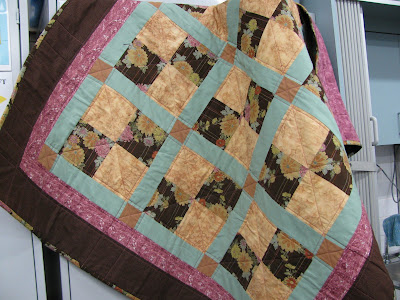
Here's Marilyn's first quilt. I used it for "Show and Tell" for my beginner patchwork class last night. We've been spending a bit of time in each lesson looking at fabric choices and I think this combination really works.

Wednesday, February 25, 2009

In the News

In this case, "in the news" is good news. Our local paper published a little story and picture about the new Patchwork by Machine class at the Neighbourhood House. Sorry, the pic is on it's side here--I don't know why, it's the right way up in my file . . .
I have borrowed Marilyn's quilt for "show and tell" at tonight's class. Hopefully I'll get to do some sewing of my own tomorrow morning. It's been a bit full-on lately.

Tuesday, February 24, 2009

Lining, Step by Step

My lined teal top is still on the "to do" pile. Meanwhile, I've completed this lined evening bag. It's a simpler shape than the top, so I've taken the opportunity to provide a step by step on the lining process.

1. Two bags, made in the same way. The darker brown is the outer layer--it's seams are turned to the inside. The lighter brown with the woven checks is the inner layer--it's seams are turned to the outside.

2. I put the inside layer on the inside, so the two sets of seams are now sandwiched together. 3. I finished the raw edges at the top of the bag by turning them to the inside and adding the bright orange casing for a cord. The row of orange stitching holds it all together.

Sunday, February 22, 2009

Blog Dilemma

A little while ago I gave out a "word puzzle" to do with "what is a good name for some-one who sews?" Today I have a related dilemma. I have two blogs. This one for beginner sewing people, and coincidentally sharing stories and pictures about my sewing. And my other blog--ztwistart.blogspot.com-- which is about my textile art work, experiences and ideas. Earlier this week, my beginner patchwork class made it into a post or two here. That seems fair enough. The issues are relevant for beginning to sew. Today my friend V's quilt made it into my other blog. It's a beauty! And it got me thinking about colour schemes which go beyond the quilt itself. That seems fair enough too. So here's my dilemma . . . when does sewing become art? Ideas please . . .

Interfacing

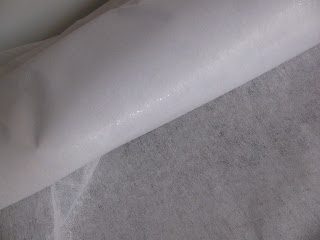
This uninteresting-looking stuff is interfacing:


In this case "uninteresting" is just fine, because this stuff is designed not to be seen. It is mainly used to reinforce or stiffen areas of fabric in a garment or project. The collar of a shirt would be a classic example. I've got it out today because I'm making a silk evening bag and I need to reinforce the base.


Interfacing comes in a variety of weights and presentations. This one is iron-on. You might just be able to see the shine of the heat-activated glue on the upper part of the pic. Here it is ironed in place:

I've folded over a corner of the fabric so you can see that it's not visible on the right side, though the fabric does, of course, handle differently.


Just a warning about anything "iron-on", make sure you don't melt a bit of the glue onto either your ironing board or the sole-plate of your iron. It makes sticky dirty marks. If in doubt, it's worth using a piece of scrap fabric in between.


There can be a bewildering array of rolls in the shop when you go to buy interfacing. If your pattern doesn't specify what to buy, you can ask for help and describe exactly what you're planning to use it for. Hopefully the sales assistant will be able to guide you through the choices.